
Anthropology of Global Climate Urgency
Doctoral Network


Living with Lower Water Levels
An Ethnography of Fishing Villages Between Kinshasa and Mbandaka

Intermediary Fieldwork Updates by Tito Muhindo Kakundika
March 2025
The province of Equateur is my research area. It is located in the north-west of the Democratic Republic of Congo (DRC). The region is crossed in its entirety by the "majestic" Congo River, which starts in the province of Haut-Katanga and flows into the Atlantic Ocean in the province of Kongo Centrale. After consultation with my PhD supervisor, Katrien Pype, I have decided to mainly focus on the village of Irebu, a strategic site located at the crossroads of the two major waterways in this area, namely Lake Tumba and the Congo River. This entity is recognised as a fishing village, considering the quantity of fish sold to travelling traders or brought to the markets of Ngombe, Kinshasa and Liranga (Congo Brazzaville) by local fishermen. This village is also vulnerable because in November 2023 and March 2024, it has been affected several times by flooding ("m'pela” in Lingala, the local language spoken in this zone). Furthermore, for many years, the Irebu community has suffered from significantly lower water levels during the dry season (“elanga”). Both floodings and lower water levels during the dry season are consequences of climate change in this landscape. Finally, this fishing village is the seat of the Ngele Group, where the "great and powerful" traditional chief who presides over all ritual ceremonies resides. Rituals are a key focus in my project.

During my second field trip (January-March 2025), I extended my research area to the villages of Malange and Etongo, both located on the other axis of the Congo River and frequented by boats connecting Kinshasa to Kisangani. There, one can also observe the movements of the whalers, artisanal infrastructures locally called "ibora" or "daka-daka" or even "mbeli-mbeli" ( Lambertz, 2023). Including this region provides me with the opportunity to integrate commercial exchanges between the fishermen and the travelling traders sailing between the villages along the river., in my research. These professional categories experience the impacts of climate change differently.
Through this research project, my efforts are directed towards:
• Identifying the new symptoms of climate change and their perceptions by different local stakeholders in and around Irebu;
• Analyzing the effects of these new signs of climate change on socio-economic activities;
• Examining the various technological responses that these local communities and indigenous peoples, particularly fishermen, implement in times of low water levels ("elanga") and flooding ("m'pela");
• Scrutinizing representations of climate change and their impacts on the symbolic spaces of the village (rituals, songs, architecture, etc.).


Online research
Well before my ethnographic field research, I focused on digital ethnography, firstly by browsing the websites of international and national organisations operating in my research area, i.e. those implementing sustainable natural resource management projects, mainly WWF, RFN, RFUK and GASHE Ongd; and those that provide humanitarian support in the villages that are victims of the effects of climate change in my study area, including Caritas Development. Secondly, I listed the audiovisual media that deal with subjects related to my research project. I analysed the digital outputs of Congolese and international media outlets such as the Congolese Radio Okapi, Top Congo FM, and RTNC (national radio and television channel), and the international media such as BBC Afrique, Voice Of America, Radio Vatican and La Croix. Finally, I followed social media posts of several people originating from Irebu and surroundings but residing in Kinshasa (capital city in DR Congo) on a daily basis, particularly Facebook, and I asked to be added to a number of WhatsApp groups for people from my observation area who live in Kinshasa or Mbandaka. These are the groups "Secteur de Lusankani", "Infos politiques Lukolela" and "Irebu mpe mboka". These interactions contributed to a deeper understanding of the political and sanitary situation and other useful information about the fishing villages before my deployment to this area where I have no access to the media or the internet.

Field research
My first mission took place between June and September 2024. I started by introducing my research project to the provincial and local authorities and requested permission to carry out the research. This process took a long time but was detrimental in laying the foundations of the fieldwork. My long stay in Irebu fostered the building of trust between the local community/indigenous people and me. Through the ethnographic approach, I was able to get close to the subjects of my study in a sustained, intimate and personal way (Ghasarian, 2004). As a participant-observer, I initially spent a lot of time watching and listening attentively to conversations, but also initiating exchanges with village leaders, government officials (immigration and river police), fishermen, farmers, hunters, transporters, street vendors, etc. I organised in-depth interviews, formally and sometimes occasionally in Lingala, the local language spoken throughout the region. And, depending on the context, I organised focus groups fishermen, dignitaries, government officials (migration and river police), fishermen, farmers, hunters, transporters, street vendors. Many farmers combine these activities with other roles: teachers, nurses, pastors, etc.


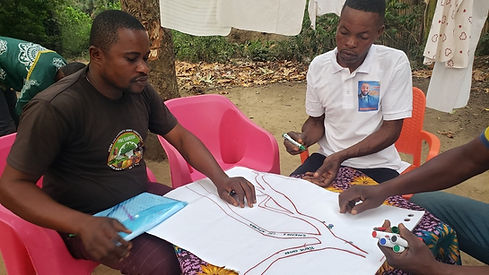
This involved presenting the data collection tools used in fishing villages, so I presented the interview guides designed for different target groups for this purpose and gathered feedback from citizen scientists on the local context.With reference to Eco-ethnography, in the field this approach involved community participation, particularly the local actors concerned by my research. I introduced the data collection tools to be used in fishing villages, and we discussed interview guides designed for different target groups for this purpose.In the first weeks in Irebu, I identified the social structure of Irebu society, and selected 7 Citizen Scientists (of whom 2 women) from among the notables, fishermen, farmers, teachers, nurses, street traders and pastors. I then organised regular working sessions with them to reflect on research project, we identified topics to be addressed and set up a list of key informants to be contacted for semi-structured interviews, as well as some associations to be lined up for focus groups. Together we developed an interview guide and survey questionnaires for the different categories to be consulted in the community.

Preliminary results
So far, my field research has yielded following results, which will be explored further in depth in a next field trip:
1. Significant disruptions in the start and end dates of the dry "elanga" and rainy "m'pela" seasons: It is difficult for fishermen and other community members to determine the beginning and end of each of these seasons. Consequently, it is also impossible to plan their activities in advance. In several accounts, they illustrate this by the fact that while it is rainy, it is rather a blazing sun that is observed in the villages, with harmful impacts on crops in the fields and fishing yields.
2. The disappearance of the "short dry season" (elanga ya muke) in favor of the rainy season, which now lasts until January or March (between 2023 and 2024, the rainy season lasted more than 10 months in the village of Etongo). Apart from Etongo, several other villages along the river do not observe this short season, leading to new lifestyles dependent on other neighboring villages, especially street traders from Kinshasa, Mbandaka, Lisala, and Kisangani;
3. Sand piles: currently observed in several villages along the Kinshasa and Mbandaka rivers, were only visible during both seasons and did not affect the passage of large floating vessels. Over time, boats have experienced serious navigation difficulties. In Irebu, for example, for 30 years, no boat has used this route, while that on the Malangé and Etongo axis, it is rather the significant reduction in the frequency of boats and the increase in whalers that nowadays facilitate the evacuation of fishing products and other agricultural products from the villages to the consumption center,
4. The straying of aquatic species: hippopotamuses (ngubu in the local language) and crocodiles (nkoli), whose habitats are disturbed by the falling water level, but also by human activities. These animals were rare in all these villages and posed no local danger. Currently, they constitute a permanent danger and disrupt movements on the river, destroy crops in the fields, etc.
5. Devastating floods (m’pela ya nyama, a common language in this village) (which can be translated as “wild floods”). Certainly, these villages are often underwater during the rainy season between October and December. For more than six years, this rhythm has undergone changes. Now torrential rains are observed from September and continue until January in most of these villages, but in others they continue until March. Incalculable impacts involve notable changes in their lifestyles, especially subsistence activities: fishing, agriculture, hunting, gathering.All of these also have significant impact on ritual life (mourning and funeral ceremonies, investiture of chiefs, healing rituals, etc.), which I have begun to explore, and which will be further explored in a next field trip.
