Anthropology of Global Climate Urgency
Doctoral Network


Final Event in Halle
Time to talk: Urging Climate Science and Communication
The C-URGE Marie Skłodowska-Curie Actions Doctoral Network held its final event from September 14 to 20, Time to Talk: Urging Climate Science and Communication at the Institute for Social and Cultural Anthropology, Martin-Luther-Universität Halle-Wittenberg Halle (Saale), Germany.
The final event featured a varied programme of activities. Here are a few highlights.
Qualitative Approaches to Urgent Climate Science
On 14 September, the C-URGE final event opened with a public conference at Martin Luther University Halle-Wittenberg. Doctoral candidates and members of the consortium developed and led three roundtables, creating space to discuss how qualitative research can help us understand climate urgency.
The discussions explored methods, climate urgency and qualitative research; urgent theoretical concepts; and how urgency takes shape across different field sites. Together, they invited participants to consider how climate urgency is experienced, interpreted and addressed in diverse contexts.
The conference concluded with reflections from C-URGE’s four principal investigators:
-
Prof. Mara Benadusi (University of Catania), Between the Permit and the Water: Climate Urgency and the Reach of Decisions
-
Prof. Asta Vonderau (Martin Luther University Halle-Wittenberg), What Holds Things Together When They Are Falling Apart? Climate Urgency and Politics After Progress
-
Prof. Susann Baez Ullberg (Uppsala University), The Chronopolitics of Climate Change: From Urgency to Horizon Work
-
Katrien Pype (KU Leuven), “Urging Publics”
The conference offered a shared space to reflect on the many ways urgency is made meaningful, communicated and encountered, and on the role qualitative approaches can play.

Bringing the Data Back to the Field
The following day, the C-URGE team travelled to Pödelwitz for a series of sessions on bringing research data back to the field. Doctoral candidates presented physical artefacts showing how they had shared, or planned to share, their research with the people and partners connected to their fieldwork.
The artefacts took different forms, from brochures and prototype albums to artworks, presentations, papers and podcasts. Each doctoral candidate explained what their artefact represented, why they had chosen that format, and how they intended to use it to make their research relevant and accessible to their field.
Participants then had time to explore the work, ask questions and offer feedback.
The Climate Urgency Around the World Science Slam at Festival OSTEN
The programme also brought C-URGE research to a wider public through the Science Slam Climate Urgency Around the World, presented at Festival OSTEN in Bitterfeld-Wolfen.
The session opened with a brief academic introduction by Prof. Asta Vonderau, who introduced the idea of “showing the urgency around the world.” As the session progressed, each doctoral candidate was introduced before presenting their research, bringing different field perspectives into the conversation. The presentation then returned to the shared theme to draw the session to a close.
Festival OSTEN uses arts and culture to explore the history, present and future of eastern Germany as a region shaped by social, industrial and environmental change. The Science Slam offered an opportunity for the doctoral candidates to share their research with festival audiences and bring perspectives on climate urgency into this broader conversation.

A Visit to Ferropolis: The City of Iron
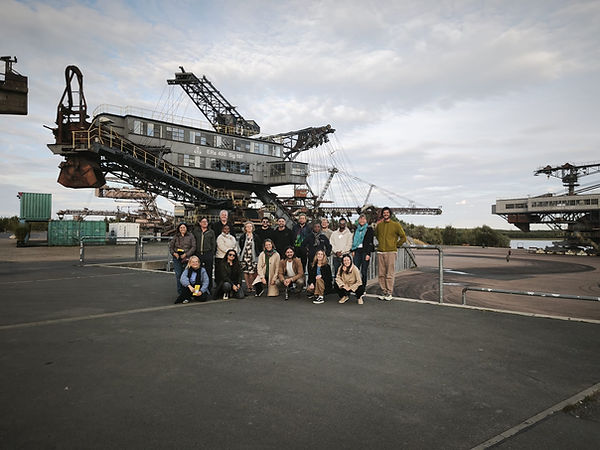
One of the highlights of the week was our visit to Ferropolis, the “City of Iron.” Walking among the enormous machines used in the former lignite mine gave us a sense of just how large-scale mining was. It was striking to see these reminders of the region’s industrial past set against the lake and landscape around them.
The visit offered a chance to reflect on how the history of energy production continues to shape the places where people live today.
Our consortium members also played an important part throughout the event. They contributed generously to the discussions, shared their experience and supported the doctoral candidates. Their involvement helped make the week feel like a real collective effort, and we are grateful for everything they brought to it.